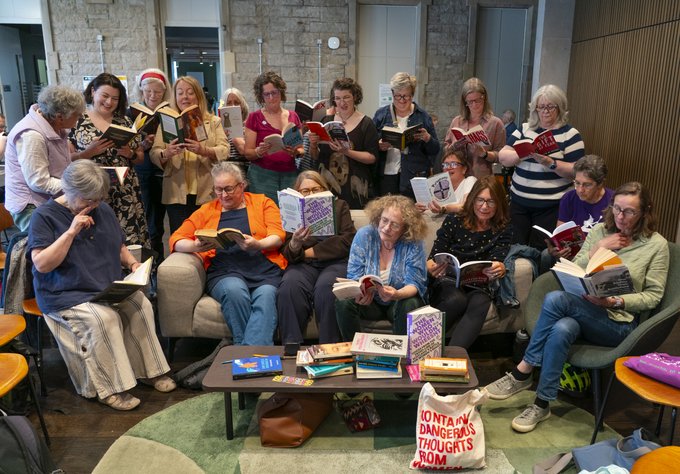
Image: Women meet to share books about women, EIBF 2026. Credit: Iain Masterton
Last year, we wrote to the Director of the Edinburgh International Book Festival, following comments she had made when asked why some recent books, including The Women Who Wouldn’t Wheesht and Jenny Lindsay’s Hounded, had not been included on the Festival programme. Our letter is here Edinburgh International Book Festival: The women who won’t wheesht respond – The Frontline.
We never received a reply. We left it there.
When Ms Niven then told the BBC, “We didn’t really feel that the books that we had on the table this year were ones that would help us to progress this conversation in a respectful and meaningful way,” we let it go. We were a bit busy dealing with The National Library of Scotland at the time.
In June this year, Ms Niven gave an interview to The Sunday Times about the 2026 Festival. The report included this:
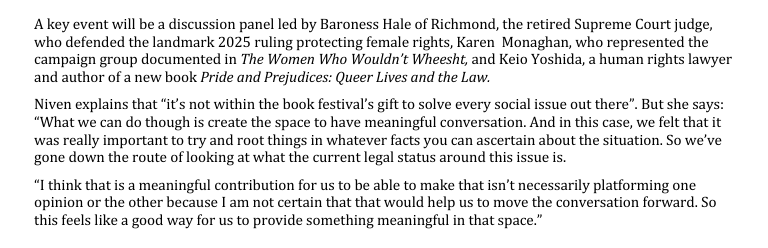
We were struck by the confusing and misleading description of the roles of Baroness Hale and Karon Monaghan in the Supreme Court case, and also the suggestion that The Women Who Wouldn’t Wheesht is the record of a single group (who deserve their own book, but ours is not that).
We were above all unimpressed with the continuing implicit message about the nature of the many women writers and campaigners in Scotland, and beyond, who believe that sex matters for women’s rights, who the EIBF was continuing to ignore. We thought the exclusion of For Women Scotland, who brought the case and saw it through multiple courts over several years, and had written about that for us, was an evident snub here.
We had one last go at trying to get the EIBF to do better, writing this time to the Chair of the Board. We said, among other things:
We attach, wearily, the unacknowledged letter we wrote to Ms Niven last year about
comments she had made then. We do not appreciate repeatedly hearing our book
diminished, and ourselves and our contributors repeatedly framed by direct implication as
impossible to platform in polite society.We further note that the panel event on 16 August is billed as inviting “audience members for a good faith discussion on this contested and challenging topic, with the aim of achieving better understanding and more empathy.” It is quite clear what those last two words are intended to imply about those not invited.
Our full letter is here. We suggested that the Board should look again at the composition of the panel, which was not balanced, to include FWS, or, if they wanted a lawyer-only panel, Joanna Cherry KC, as someone who had been close to the arguments here (assuming either would be willing to do this). We also noted the experience of novelist and poet Polly Clark at the EIBF in 2024 as further context.
This time, we did at least get a response, from the Festival’s Vice Chair. Generic in tone, it side-stepped the main argument. You can read it here. We thought we would wait until after the event, before responding.
Although For Women Scotland were not on the platform, they did attend yesterday and have commented on the event here.
So we have written what we hope will be our last letter to the EIBF.
Thank-you for your email of 15 July. At least we got a reply this year.
So that it becomes part of your formal record, we attach the reflections published today by For Women Scotland about yesterday‘s event. These show how their presence on your
stage would have enriched the discussion. The Board chose to deprive the audience of that.Our letters this year and last were sent directly in response to public comments by your
Director. You have made it clear that she is doing this with the support of the current Board. What a shame.Nothing remains but to publish these exchanges, and perhaps look forward to a time when
the Festival’s management is no longer an annual source of gratuitous disparagement for
women it has, sadly, had too little courage or curiosity to platform.
EIBF tote bag from sometime in the recent past

