As co-editors of the Sunday Times bestseller, The Women Who Who Wouldn’t Wheehst, we might have expected to have been invited to the 2025 Edinburgh International Book Festival, along with writers such as Jenny Lindsay, whose book Hounded tells of the harm done to women cancelled at the height of the gender debate. But the invitation never came.
One book-lover wrote to EIBF’s director Jenny Niven, to express her disappointment at our exclusion. In her email response, Niven said she felt any discussion around women’s rights and gender feels “extremely divisive”. The story was covered in the Mail on Sunday and The Times
Today we have written to Ms Niven responding to her email line by line. Her comments are in bold.
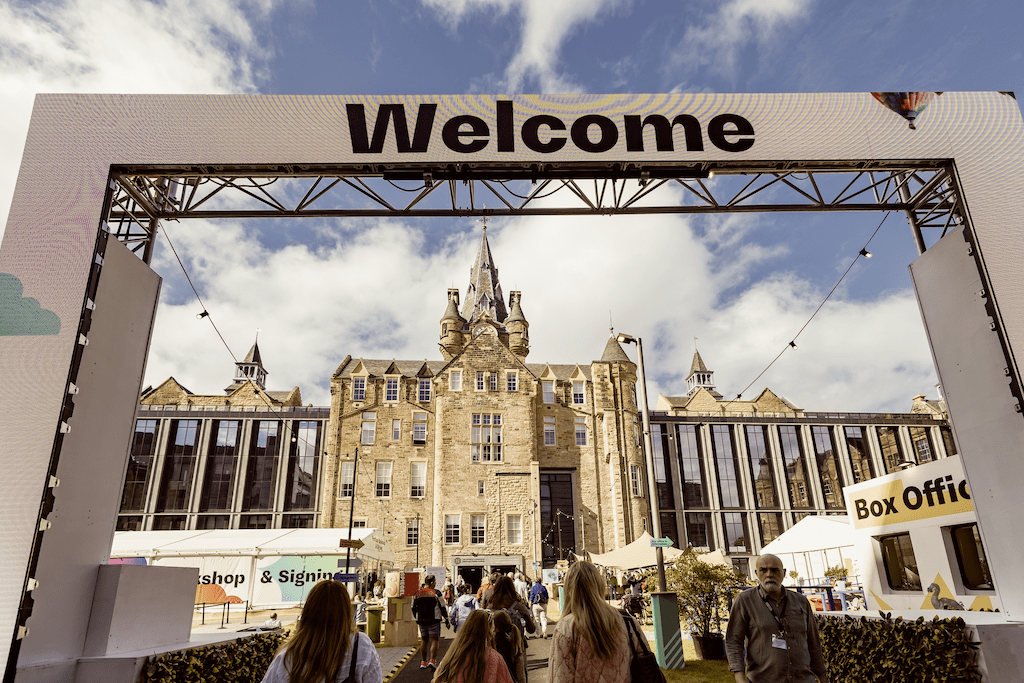
Edinburgh International Book Festival 2024 Pic via iStock
4 August 2025
Dear Ms Niven
We have seen your email to a member of the public who questioned the exclusion of The Women Who Wouldn’t Wheesht from the book festival’s 2025 programme.
We have taken the opportunity to respond to each of the assertions in your email. However, our first question must be: have you read the book?
You say: “we work very hard to ensure that the conversations that happen on our stages are rigorous, informed and fair.”
Our book is all those things. It is of course, written from the perspective of the 30-plus women who tell their own stories. You evidently do not require every book on any subject where people disagree, to tell stories from or argue for both sides. In any case, had you asked us to participate in an event with someone who holds a different view, we would have been open to that, and remain so. However, under your own criteria anyone who has been involved in hounding women on this topic, or using inflammatory rhetoric towards them, presumably disqualifies themselves: that would rule out at least one individual on your programme already.
You say: “As you can see from the range of other challenging topics addressed in the programme we don’t shy away from difficult conversation.”
Yet this is exactly what you have done here.
You say: “However at present the tenor of the discussion in the media and online on this particular subject feels extremely divisive. We do not want to be in a position that we are creating events for spectacle or sport or raising specific people’s identity as a subject of debate.”
We object very strongly to the implication that an event discussing our book can only be “for spectacle or sport.” We also object to the implication that the book’s purpose is to debate minority identities. It recounts the personal experience of over 30 women who stood up for the importance of sex in language, law and policy, and in many cases suffered significantly for doing so. The people who put identity up for debate were the politicians and activists who reframed “woman” as an identity. Your logic is that women who resisted that should be silenced.
You say: “We have a duty of care to our speakers that they will be treated fairly and with respect. Given the inflammatory tone of a great deal of media – on all ‘sides’ of this discussion – we did not feel it to be the right move for us to host a conversation which appeared to pit the rights of one minoritised group against another.”
Again, we strongly object to that characterisation of a conversation about our book. Once again, it is a book about the experiences of women in Scotland in a particular period, who spoke out on a particular subject that mattered to them, in their own lives. You have treated them with great disrespect in characterising the book in the way that you do. You mention “all sides”. Who do you think the threat would come from, for the speakers at an event about our book? They would be no risk to us from the many women who have expressed their gratitude to us for the existence of this book. If your fear is people who disagree with us, then you are giving into bullies.
You say: “In the main, the sessions involving people who identify as trans in the 2025 programme are not programmes designed to discuss the outcome of the Supreme Court ruling. And where there are gender critical writers in the programme, they aren’t either and are more likely to be discussing their fiction.”
An event about our book would not be a session to discuss the Supreme Court ruling, even though that topic might, reasonably, come up. At the risk of repeating ourselves, it would discuss the experience of women in Scotland who stood up for their rights as a group with a shared sex, and what happened when they did. As editors, we would discuss why we thought it was important that women should have the opportunity to record those experiences in their own voices and how we went about pulling the book together.
By making a contrast with “trans authors” and “gender critical writers”, you fail again to understand that the book is about what people think, not personal characteristics. We do not know what all your authors, trans or otherwise, think about this subject. But some have well known views here. There are several events on the programme where the opposite perspective to ours is likely to be actively asserted from the platform. That there are just two (we think) writers on your programme of 600 events who have at any point been labelled as “gender critical”, participating in events where this issue is unlikely to come up at all, is no sort of balance.
You say: “I appreciate you feel we should have platformed this issue more directly. Staging difficult discussions takes time, resource and care, and each year we have to make choices about where to prioritise. For this year, we’re focussing more on geopolitics, among other things.”
Our book was published in May of last year. Jenny Lindsay‘s book Hounded came out in the autumn last year. There has been plenty of time to talk to us about such an event and how to run it. You have chosen to avoid a subject which has contributed to the resignation of one, arguably two, first ministers in Scotland, and has been a continuing major theme of public debate across the UK and beyond.
You say: “I wholeheartedly agree with you that repair in this area is much needed, and if there are books in the future published which themselves help move the conversation towards a more reparatory (sic) perspective we’d certainly consider them for the programme.”
This is an outrageous position for you to take as a book festival. You set conditions here on anyone writing from our perspective that they must meet your test of being sufficiently “reparatory” before you will give them a platform. Can you show us where you have asked authors speaking about books dealing with their personal experience from the other perspective to be “reparatory” enough before you platform them?
The festival’s programming over recent years has shown no sign of that. There are people featured on your programme this year whose high-profile activities have been the absolute opposite of reparatory. We would be interested to learn what assurances were required from the former First Minister on this topic before you agreed to platform her.
The Women Who Wouldn’t Wheesht has been widely described as significant. It captures an important period in Scotland’s recent political and culture life and is written by a diverse group of women. They include one of the first two women of colour to be elected to the Scottish parliament since devolution in 1999. Two survivors of sexual assault, who could only write anonymously, recall their exclusion from the political process. And one quarter of the contributors are lesbians.
It is thoughtful, at times challenging but always respectful. It is, we think, one of only two books with a strong Scottish politics theme to make the Sunday Times bestseller list since devolution. The other is Darren McGarvey’s Poverty Safari.
We are disappointed that we were not given the opportunity to discuss the book in our own city. But if EIBF does not want to hear our voices, perhaps they will heed the words of John Swinney who earlier this week said our society is healthier when we can all express our views particularly on issues of the greatest sensitivity.
It’s worrying then that EIBF, one of Scotland’s most important cultural institutions, appears not to share the First Minister’s belief in freedom of expression. By excluding and misrepresenting us, the book festival has failed in one of its core principles – to provide a platform for nuanced conversations between people with diverse views and experiences.
In conclusion, we would like an apology for the way our book has been represented by the EIBF, and to know where else and with whom it has been discussed by you in these terms. We also wish to meet with you and hear you explain the position you have taken about our book in person.
Meanwhile, we attach the report produced by SEEN in Publishing which gathers information about the hostile climate in the publishing industry for those who hold the ordinary, lawfully protected and legally accurate view that sex is a lifelong characteristic and that recognising this in law is the basis for women having meaningful rights.
We look forward to your early response.
Yours sincerely
Susan Dalgety and Lucy Hunter Blackburn
Editors, The Women Who Wouldn’t Wheesht
- National Librarian apologises for her “lack of clarity” in recent Front Row interview
- Statement in response to formal apology from the National Library of Scotland
- The Women Who Wouldn’t Wheesht: Statement in response to an open letter to the National Library of Scotland from activists in the ‘academic, heritage, arts, literary and cultural sectors’
- The Women Who Wouldn’t Wheesht: Letter to the convener of Scottish Parliament’s culture committee in response to the National Library of Scotland’s recent report on its decision to exclude the book from its centenary exhibition
- Correspondence with the National Librarian where she offers a meeting in a month’s time, after NLS carries out its own private investigation
 The Frontline